What’s an ND… and why should you see one?
There are all kinds of healthcare providers in all kinds of fields. They all offer something different, all practice in unique ways, and all bring a unique style and skillset to what they do. The letters behind their names matter far less than
Whether or not you like them,
Whether or not they listen to you,
If the way they practice is a good match for your style,
Whether or not you think seeing them is a good choice for your financial health, and
If you walk out of their office feeling better and/or more hopeful than when you walked in.
Whatever the variety of provider — medical doctors (MD), osteopathic doctors (DO), naturopathic physicians (ND), certified nurse practitioners (CNP), nurses (RN), medical assistants (MA), dentists (DMD), acupuncturists (LAc), massage therapists (CMT), nutritionists (CNS) — it matters most is your experience!
This article is not to convince you to see any particular type of provider (only you can say who is the right fit for you), but to highlight where NDs shine, how they approach medicine, and where they fit into the rest of the healthcare ecosystem.
Education
A super common question NDs get: “But are you an actual doctor?”
Heartily I say: Yes!
Typically this question boils down to a misunderstanding of two things: a misunderstanding or ignorance about our education and the modalities NDs use.
Here’s the rundown of what a naturopathic medical education includes:
2 years of didactic biomedical education,
2 years of clinical education,
Training in pharmacology, hydrotherapy, nutrition, physical medicine, herbal medicine, homeopathy, and IV therapies, and counseling.
Optional specialized training in unique areas of interest.
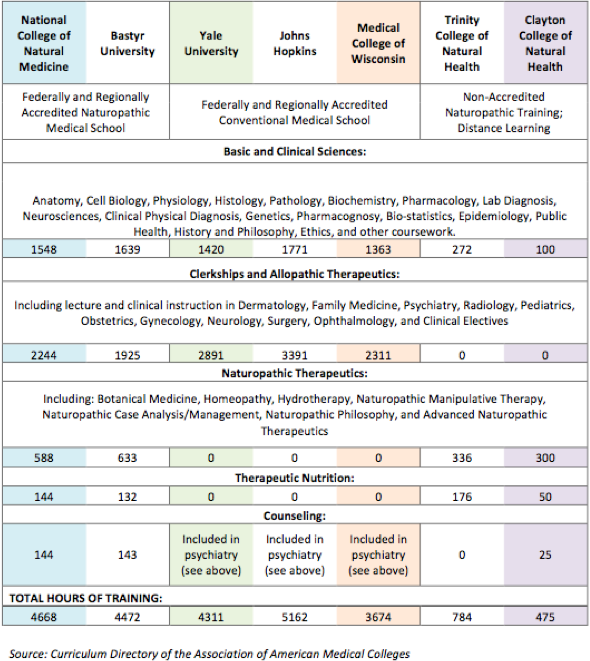
Take a look at the chart on the right (—>) for a more detailed look at how the hours pencil out between curricula.
In essence, NDs receive the same amount of biomedical education as do MDs. We also receive hundreds of hours in excess of MDs when it comes to foundational wholistic and integrative therapies like nutrition.
Also, as a consumer, pay close attention to the labels used. Note that an ND is not the same as a “naturopath.” Both accredited and non-accredited schools exist. Someone who has attended a non-accredited program may call themselves a ‘naturopath.’ In the far right column in the cart above are listed education hours — note the incredible lack of medical training included in these programs.
Thus, only someone with a Doctorate in Naturopathic Medicine (ND) is considered a Naturopathic Physician.
Approach — The Principles of Naturopathic Medicine
Having established that NDs are actually doctors, the next question is, what makes them different from MDs or DOs?
It comes down to the Principles of Naturopathic Medicine, which guide a practice of medicine rooted in the wholistic and natural world, focused on partnership, with the goal of helping patients heal.
Let’s address these principles one at a time:
First do no harm
— A principle is shared by every healer — this is certainly not unique to NDs.
Doctor as teacher
— Naturopathic physicians teach their patients. We aspire to put ourselves out of a job — to have our patients be experts in the inner workings of their own bodies and what inputs facilitate exceptional physical function. Armed with this knowledge, patients can then take the very best care of themselves and experience reliable and ongoing wellness. In other words, I have expertise but you have experience — the more I can share my expertise and make it yours, the better experience living in your body you will have.
The healing power of nature
— Most illness is the result of humans living contrary to and out of sync with the natural environment. Think getting to bed far later than it is dark outside, breathing re-filtered and stale air, eating processed pseudo ‘food’ and sitting at a computer and in traffic for hours on end. Life in the ‘civilized’ world. While most NDs love the conveniences and ease of the modern world and certainly wouldn’t recommend you do without (a roof, walls, and heating are a marvelous thing in the winter! What wonders of nutrition does a grocery store behold!), we do want you to practice getting more sleep than you think you need, experiencing the outdoors more, moving more than you think you need, and getting real foods into your diet. Naturopathic medicine emphasizes that when we remind ourselves to live in harmony with the natural world, health is an inevitable by product.
Identify and treat the cause
— While sometimes a masking of symptoms is necessary (i.e. putting on a band-aid, managing severe pain, etc), NDs are obsessed with getting to the root cause of illness or disease. We don’t want to mask your symptoms — we want you to not have symptoms. Like pulling up a weed from the roots, we work with you to figure out where the experience of dis-ease and symptoms is coming from. Is it your mindset? Nutrition? Sleep? Relationships? A metabolic process gone wonky? Hormonal shifts? Nervous system on overdrive? We work with you identify the root cause and make whatever shifts are needed to improve your experience.
Treat the whole person
— You are not only a body! Furthermore, your body is not just a carrier for your brain. You are a fully formed, complex human made of physical, emotional, and spiritual components. You have social connections, a home, work, friends, food you like, preferences for surroundings, unique quirks and habits… all of which make you uniquely you (how lovely!) and play a role in your health or lack thereof. NDs take in all the parts and are trained to work with and help you optimize all of them so that every aspect of your perfect and unique being is healthy and well.
Prevention
— Have you ever been to your doctor, told them what was going on, and had them say, ‘Well, there’s no real diagnosis here. Come back when it gets worse!” Yeah — your ND will never say that to you; we simply have too many options we know will help! We perform preventive in-office testing (blood work, physical exams, well-woman exams, etc) and always have some tricks up our sleeve to restore ease and full functionality to your body, mind, and spirit. We as NDs know that taking care of yourself today pays exponential dividends tomorrow.
When is the best time to see an ND?
Yesterday.
Just kidding!
… Well, sort of.
Although naturopathic physicians are well equipped to handle some acute and short term illnesses (cold, flu, muscle sprains/strains, headaches, back pain, etc), we shine when either
Symptoms are vague and yield no clear diagnosis,
Chronic diseases like diabetes, heart disease, high cholesterol, etc are the main issue,
You have a diagnosis, but is an ‘invisible’ disease, like fibromyalgia, chronic fatigue syndrome, complex regional pain syndrome, etc, or
You simply want to be at your best!
So, the best time to see an ND is… today?
Licensure and Scope of Practice
This is where things start to get dull and complicated — a drear combination. But it is part of what makes NDs and our practice unique, and it also a question I get with regularity. I’ll answer it in stages, as there are many parts to address.
1.What is a license?
Just like your driver’s license lets you drive (legally), and a fishing or hunting license say you are allowed by the government to be out hunting or fishing, a medical license lets doctors practice medicine (i.e. diagnose and treat illness).
2.Why does a license matter?
Because it lets you know that your doctor has been educated properly, is an upstanding citizen, and is qualified to diagnose your illness and provide appropriate medical treatment.
There are some professions — like herbalism — that are currently unlicensed in every state. The debate rages on for this profession (and others I’m sure) because while a license provides a standard practitioners must maintain for consumer safety, it also requires a lot of output from the provider. Time, money, and energy for education, more money and time to take examinations to qualify for the license, and yet more money to pay for license maintenance on an annual basis. For something like herbalism, which has been practiced — by women especially — for centuries, a license seems a bit, well, much. It takes the medicine out of the hands of the people and puts it into the hands of administrators.
All of which I share simply to provide context: you want your doctors to be licensed. You (and I) as a consumer want to know that the doctor knows what they are supposed to know, and are competent to the standard (if not higher) in their field. A license provides this assurance.
3.What is scope of practice?
Scope of practice refers to what treatments a provider can, well, provide. The scope of an MD includes prescription meds to major surgery. Chiropractors may perform physical adjustments and make lifestyle recommendations. Physical therapists provide therapeutic exercise and guidance. Dentists can also prescribe medications and do procedures on your teeth.
The scope of practice for a naturopathic physician varies from state to state, along with licensing laws.
4.What about licensing is unique to naturopathic physicians?
While most every other healthcare provider enjoys a standard scope of practice across the country, ND licensing and scope varies widely. Some states do not grant licenses to NDs (as of this writing such states include Nevada, South Dakota, Nebraska, Missouri, Arkansas, Louisiana, Kentucky, Alabama, Tennessee, South Carolina, and West Virginia, among others. You can look here to see what states are currently looking to implement licensing laws for NDs). In some states, NDs have a very limited scope of practice, and are unable to prescribe prescription medications and order certain lab tests.
In other states, like Washington and Oregon, NDs are considered primary care providers, which means that they can:
Bill insurance,
Order any lab or imaging tests,
Prescribe most any pharmaceutical medication,
Complete full physical exams and preventive testing in their offices,
Make referrals to specialists,
And generally do anything your family doctor or general practitioner would do for you.
Phew! We made it! That was a lot of information, and hopefully helpful. The things to remember are that yes, NDs are doctors, our principles make us uniquely qualified to treat diseases of lifestyle (diabetes, cardiovascular disease, etc), functional disorders (intestinal problems, etc), and ‘invisible diseases’ (fibromyalgia, chronic fatigue, etc). Although all of this is true, depending on where you live in the United States, the care you receive from your ND will vary, as licensing laws and scope of practice do.